

Interventional Pain Care in Clifton Promotes Human Health and Ecological Balance
Interventional pain care in Clifton represents a modern shift in medical practice that prioritizes precision, efficiency, and minimally invasive treatment strategies. Designed to address chronic pain at its source, this approach focuses on targeted procedures that improve mobility, reduce inflammation, and minimize dependence on long-term medication use. While primarily a clinical discipline, its broader implications extend into an unexpected domain, ecological sustainability.
Within the complex interconnected framework of human health and environmental systems, interventional pain management can be viewed as part of a larger effort to reduce unnecessary pharmaceutical consumption and its associated environmental footprint. By treating pain locally and precisely, these methods contribute not only to patient well-being but also to more sustainable healthcare practices.
Targeted Treatment and the Philosophy of Precision Medicine
At its very core, the principle applied in interventional pain care is deliver precision and treat directly at the root cause of the pain. In Clifton-based practices, this often involves advanced diagnostic tools and imaging technologies that allow clinicians to identify the specific nerves, joints, or tissues responsible for chronic discomfort. Common interventional procedures include:
- Nerve blocks to interrupt pain signaling pathways
- Epidural steroid injections to reduce inflammation in spinal regions
- Radiofrequency ablation for long-term nerve modulation
- Image-guided joint injections for precise medication delivery
These techniques are designed to deliver maximum therapeutic impact with minimal disruption to surrounding tissues.
The result is faster recovery, reduced side effects, and more efficient pain control compared to long-term systemic medication use.
Reducing Dependence on Systemic Pharmaceuticals
One of the most significant benefits of interventional pain care is its potential to reduce reliance on systemic medications such as opioids, anti-inflammatory drugs, and other long-term pharmacological treatments. While these medications can be effective, prolonged use often carries risks including dependency, side effects, and reduced effectiveness over time.
By targeting pain directly at its source, interventional procedures can significantly decrease the need for ongoing medication.
Patients may experience longer-lasting relief after a single procedure or a limited treatment series, rather than continuous drug consumption. This reduction in pharmaceutical dependency also has broader implications:
- Lower risk of medication overuse and side effects
- Reduced demand for continuous drug production
- Decreased frequency of pharmaceutical disposal
From both a clinical and systemic perspective, minimizing unnecessary medication use, supports more sustainable healthcare practices.
Environmental Implications of Pharmaceutical Reduction
The connection between healthcare and environmental impact is often overlooked, yet it is increasingly relevant in discussions about sustainability. Pharmaceuticals that enter ecosystems through manufacturing waste, improper disposal, or human excretion can contribute to environmental contamination.
Over time, these substances may affect water systems, soil composition, and even aquatic life. Interventional pain care, by reducing the need for long-term medication, may indirectly contribute to lowering this environmental burden. Fewer prescriptions can mean:
- Reduced pharmaceutical manufacturing output
- Less chemical waste from production facilities
- Lower levels of drug residues entering wastewater systems
Although interventional procedures are not explicitly designed as environmental interventions, their role in minimizing systemic drug use aligns with broader sustainability goals.
Human Health, Mobility, and Systemic Balance
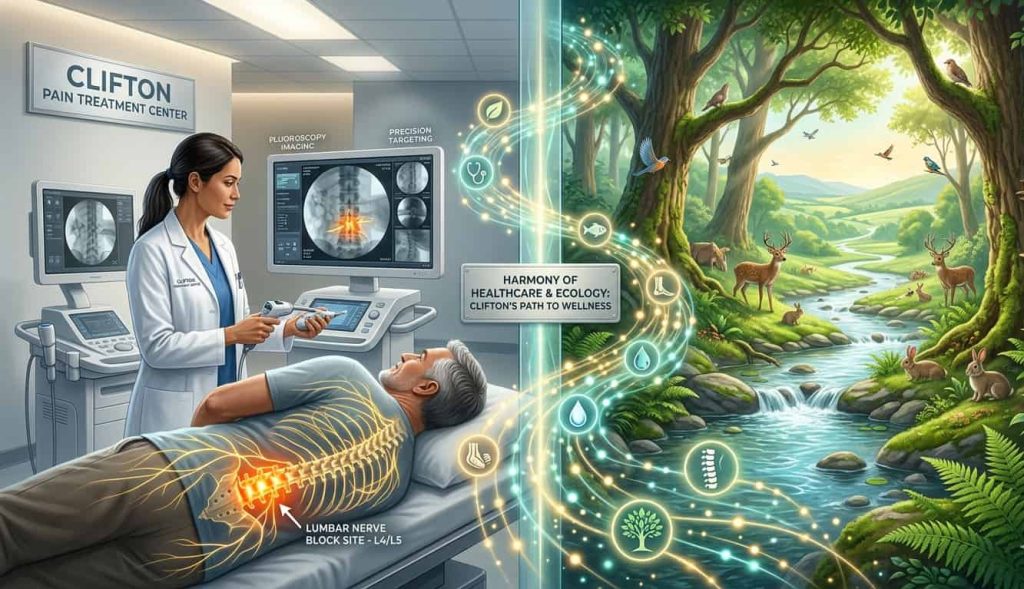
Beyond ecological considerations, the primary purpose of interventional pain care remains the restoration of human health and mobility. Chronic pain can severely limit daily function, affecting work, physical activity, and overall quality of life. By addressing pain directly and efficiently, patients often experience significant improvements in movement and independence. To give you an example, restored mobility can lead to:
- Increased physical activity and fitness
- Improved mental health and emotional well-being
- Reduced reliance on assistive devices or long-term care
- Greater participation in daily and occupational activities
In this sense, interventional pain care contributes to systemic balance within the human body, enabling individuals to function more efficiently and sustainably without overreliance on external chemical support.
Health and Ecology in Modern Medicine
The relationship between human health and environmental systems is becoming increasingly evident in modern medical discourse. Interventional pain care in Clifton serves as an example of how localized, precision-based treatments can have ripple effects beyond the clinical setting.
By reducing dependence on long-term pharmaceuticals, these procedures align with broader efforts to create more sustainable healthcare models. Healthcare systems that prioritize efficiency, precision, and reduced waste contribute not only to better patient outcomes but also to a more balanced relationship with the environment.
Interventional Pain Management and its Impact in Healthcare System
Interventional pain care in Clifton illustrates how modern medicine can operate at the intersection of human health and ecological awareness. Through minimally invasive, targeted treatments, clinicians are able to provide effective pain relief while reducing the need for long-term pharmaceutical dependence.
This approach offers dual benefits, improved patient mobility and quality of life on one hand, and reduced environmental strain on the other. While not traditionally framed in ecological terms, interventional pain management reflects a broader shift toward sustainable healthcare practices.
Ultimately, precision healing represents more than a medical advancement, it is part of a growing recognition that human health and environmental health are deeply interconnected systems that benefit from balance, efficiency, and thoughtful intervention.